Healing is something that miraculously happens to us, right? Especially when we’ve been diagnosed with something “incurable.” I mean, if the doctors and specialists don’t have the answers, and they’re telling us to prepare for a bleak future, we’re just screwed, right?
UNLESS…
We’re one of the lucky ones. One of those select, special people who beat the odds and get better despite a dire prognosis. One of the “miracles.”
Maybe we become a calmer, lighter version of ourselves. Someone who isn’t triggered so easily. Someone who finally figures it out. Or maybe a symptom disappears.
So we wait.
We read. We reflect. We try to understand.
We tell ourselves we’re “doing the work,” even when nothing in our lives is actually changing.
And when the same patterns return—when we react the same way, shut down the same way, or reach for control in the same way—we don’t question our approach.
We question ourselves.
Why am I still like this?
Why can’t I just let it go?
What’s wrong with me?
But I don’t think there’s anything wrong with us.
I think there’s something incomplete about what many of us have been taught about healing.
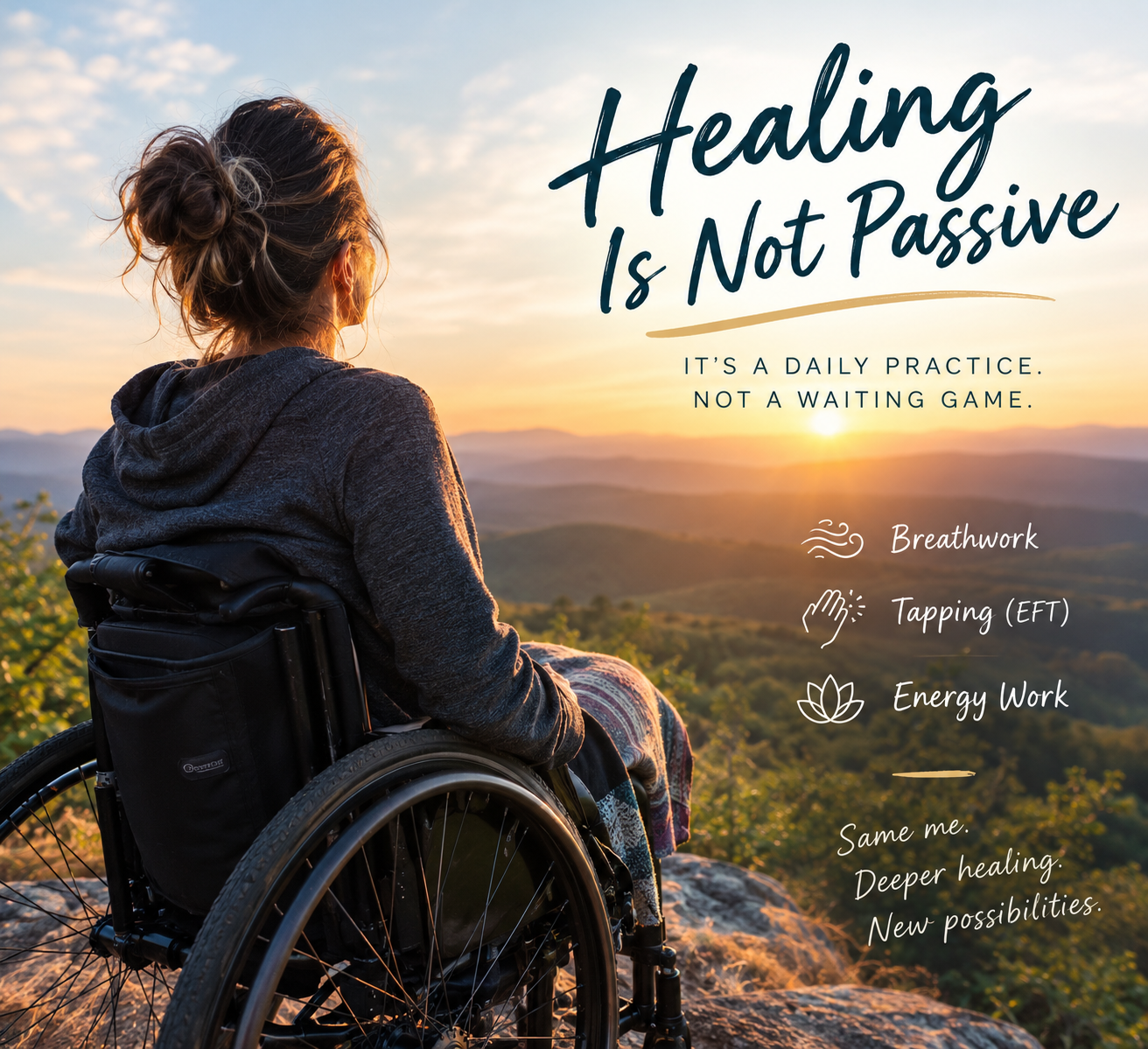
Healing isn’t passive.
It isn’t something that happens while we stay the same.
It asks for our participation.
Sometimes that participation feels uncomfortable, unfamiliar, or deeply exposing. It asks us to stay when our instinct is to run. To soften when our body wants to brace. To feel what we’ve spent years avoiding.
Not all at once. Not perfectly.
But intentionally.
I think this is where so many of us get stuck. Not because we’re incapable of healing, but because we’ve learned to approach healing in ways that keep us safe—and stuck—at the same time.
We confuse awareness with change.
Insight with transformation.
Time with healing.
But awareness without action is simply observation. And observation alone doesn’t necessarily create a new experience in the body.
For a long time, I believed healing meant getting back the life I’d lost. Getting out of the wheelchair and returning to the version of myself who existed before Multiple Sclerosis rearranged everything.
Lately, though, my understanding has started to change.
I’ve begun to see my illness as an invitation to look at my life differently. To slow down. To examine the things I’d never taken the time to question. To hold a magnifying glass up to my beliefs, my patterns, and the ways I’d learned to navigate the world.
Maybe healing isn’t about getting back to who I was.
Maybe it’s about discovering who I am beneath all the conditioning, fear, and survival strategies.
Healing isn’t happening to me.
It’s asking something of me.
Not positive thinking.
Not pretending everything is okay.
Not waiting patiently until I feel better.
Participation.
Presence.
Practice.
So what does that participation actually look like?
People often ask me this, especially since I’ve written about meditation so many times. Meditation has been an important part of my journey, but it’s no longer the only practice I’m relying on.
For me, healing has become a collection of daily somatic practices: breathwork, tapping (EFT), and energy work.
I no longer think of these as things I do until I “feel better.” They’ve become part of how I care for myself.
In a way, they’re my medicine.
Like taking a prescription every day, consistency matters.
And honestly, why wouldn’t I continue practices that improve my mood, help me manage stress, and support my overall well-being? I’m still discovering what they might offer me over time.
Here’s what that looks like in my life right now.
Somatic Therapy: Learning to Listen to My Body
Somatic therapy is rooted in the understanding that the mind and body are deeply connected. The word somatic comes from the Greek word for “body,” and that’s where I’ve been focusing my attention lately.
I’ve been learning to listen to what my body is experiencing instead of automatically pushing past it, ignoring it, or trying to think my way through everything.
And the more I slow down and listen, the more I notice.
Sometimes, when I sit quietly, ask myself what I need, and allow myself to hear the answer without immediately judging it, things become surprisingly clear.
I think we’re often more intuitive than we realize. We just don’t always give ourselves the time or space to listen.
Stress, grief, fear, and trauma aren’t simply memories or thoughts. They can also influence how our nervous systems respond to the world around us.
Many of our automatic responses begin taking shape in childhood, as our brains learn to navigate experiences and protect us from perceived threats. Fight, flight, freeze, and fawn are familiar ways of responding when we feel unsafe or overwhelmed.
These responses may have helped us cope at one point in our lives. The problem is that patterns developed for protection can continue long after the original circumstances have changed.
We can understand why we respond a certain way and still find ourselves doing it.
That’s why, for me, healing isn’t just about understanding my emotions or figuring out where my patterns came from. It’s also about practicing new responses and helping my body experience a greater sense of safety.
The two somatic practices I’ve committed to every day are breathwork and Emotional Freedom Techniques (EFT), also known as tapping.
Ironically, I wrote about both of these practices back in 2023 in my blog post, The Victim or the Creator.
I already knew about them.
I just wasn’t consistent.
Breathwork: Working With My Body, Not Against It
Every morning and evening, I use guided breathing sessions from Breathe with Sandy on YouTube.
He has around 250 videos, with different lengths, styles, and purposes. I love having so many options because I don’t need the same thing every time.
Some sessions are designed to down-regulate the nervous system and encourage relaxation. These often use slow, controlled breathing with longer exhales, which can influence heart rate and support the body’s relaxation response.
The vagus nerve plays an important role here. It connects the brainstem with organs throughout the body and is a major part of the parasympathetic nervous system—the branch associated with “rest and digest.” Through its two-way communication between the brain and body, it helps regulate functions such as heart rate and digestion.
Other sessions use more active breathing to up-regulate, helping me feel more energized and focused.
There are practices for emotional release, self-discovery, CO₂ tolerance, and respiratory efficiency. Some help me work through emotions, while others simply help me release tension I didn’t realize I was carrying.
And because the sessions range from just a few minutes to much longer practices, I can choose what fits my body and my day.
That’s one of the things I appreciate most about breathwork. It isn’t one-size-fits-all.
Some days I need to calm down.
Some days I need to wake up.
Sometimes I need to process something emotional, and sometimes I just need to breathe.
Research suggests that intentional breathing can influence heart rate, autonomic nervous system activity, and our experience of stress. But beyond the research, I’ve noticed a difference in my own experience.
My body responds differently when I intentionally work with my breath instead of against it.
And that feels important because I’m learning that healing isn’t necessarily about sitting back and waiting for my body to change.
It’s about participating in the process.
Learning my body. Paying attention. Trying things. Creating new experiences and responses.
Breathwork is one small way I can do that.
I’m not forcing my body to heal.
I’m learning how to work with it.
Emotional Freedom Techniques (EFT): Showing Up With Compassion
I’ve written about tapping before, but for a long time, I struggled to make it a consistent practice.
The biggest obstacle?
I never knew what to say.
Recently, I discovered Amy Scher, an award-winning energy therapist, mind-body healing expert, and bestselling author whose own healing journey led her to explore energy therapy and help others work through emotional challenges.
Her work introduced me to a different way of thinking about emotional wounds. They aren’t just stories we carry in our minds. Our past experiences can continue to influence our emotional and physical responses long after the original events have passed.
Tapping combines focused attention on thoughts and emotions with gentle tapping on specific points on the body, often called acupressure points.
For me, there’s something fascinating about acknowledging what’s actually happening inside me while engaging in a physical practice that helps me slow down and meet those feelings with compassion.
Eventually, I reached out to Jennifer Miranda, one of Amy Scher’s certified practitioners, and began working with her one-on-one.
Together, we’ve explored subconscious beliefs, old emotional wounds, and patterns I never realized were still shaping how I experience life.
Jennifer records our sessions and provides personalized tapping scripts for me to practice on my own. For the first time, tapping feels accessible instead of intimidating, and it’s become part of my morning routine after breathwork.
What has surprised me most isn’t the technique itself.
It’s how much can come to the surface when I stop trying to force myself to change and instead approach myself with curiosity and compassion.
I’m beginning to see that I don’t have to fight against the parts of myself I want to change. I can acknowledge them, understand where they came from, and gently practice something different.
Maybe that’s the bigger lesson I’m learning through all of this.
Progress hasn’t come through dramatic breakthroughs.
It’s come from showing up every day with curiosity, consistency, and kindness.
Not forcing.
Not fixing.
Not waiting.
Participating.
Energy Work: Turning Insight Into Practice
I’ve also begun working with a local energy practitioner and spiritual guide who specializes in psychedelic integration.
For a long time, I prayed to find someone nearby who understood both energy work and psychedelic-assisted healing.
Earlier this year, Jeremy and I attended a health and wellness fair in Bloomington, where we met someone from the Indiana Psychedelic Society. That conversation eventually opened the door to this work.
At the risk of being controversial, I’m going to share something personal.
I’ve found psilocybin-containing mushrooms to be one of the most effective tools I’ve experienced for helping me with depression.
My first experiences were in college, and even then, I noticed an unusual sense of joy and openness. Years later, Jeremy and I tried them again, and I experienced a similar shift.
Since then, I’ve incorporated microdosing into my healing journey when I’ve felt it was appropriate and available. In my experience, the difference I’ve noticed in my mood has been more significant than with any antidepressant I’ve tried.
I recognize that everyone’s experience is different, and my experience isn’t a recommendation for anyone else.
For me, though, these experiences have been meaningful.
That said, this isn’t about chasing extraordinary experiences or looking for something outside myself to make everything better.
It’s about making sense of what comes up and learning how to integrate it into my everyday life.
The real work happens afterward.
Integration means taking whatever insights emerge—whether through meditation, altered states of consciousness, or profound life experiences—and asking:
How do I actually live this?
How do I take something I’ve come to understand intellectually and begin applying it to my daily life?
How do I respond differently when an old trigger shows up?
How do I recognize a familiar pattern and choose a new response?
How do I carry the awareness I experience in a moment of clarity into the messy, ordinary moments of being human?
It means translating awareness into behavior.
Understanding into practice.
Insight into change.
And that’s becoming my definition of healing.
Not returning to who I was.
Not becoming someone new.
But participating, day after day, in the process of uncovering the person I was before fear, conditioning, and survival strategies convinced me I had to become someone else.
Through consistency, patience, and self-love, I’m learning to meet myself where I am while continuing to grow into who I want to be.
Healing isn’t passive. And surrender isn’t giving up.
I can’t control every outcome, and I can’t force my body to change on my timeline. But I can choose how I participate in my own healing.
I can show up.
I can listen.
I can practice.
I can keep learning.
And maybe that’s where the real transformation begins—not in waiting for a miracle, but in becoming an active participant in the life I’m living right now.
Leave a Reply